Project Summary
Dates:
Sep 4, 2023
Context:
University of Washington - Seattle
Themes:
How I got Here:
In September 2023, I got an email from the University of Washington, asking me to interview for what I believed was a TA position. Instead, I was asked to teach Introduction to Technical Communication for undergraduate engineering students, a course that I had taken many years prior. I had no formal teaching education or experience, and the class was slated to begin in two weeks.
I said yes.
The Challenge:
Engineering 231, or Intro to Tech Comms, was a required class for most undergraduate engineering students. As a result, it was often seen as an irritating box to check, after all, students were here to learn Engineering, not writing.
In my work as a User Researcher, I had worked with myriad Engineers and Designers, seeing firsthand how vital communication was to every element of professional life. The skills I had learned in this class when I was student had been useful almost every day of my career, and this was their once chance to learn the fundamentals. Additionally, this course was the closest engineering students got to a required ethics class.
The course had 4 major assignments, and while I had to make sure I was following the guidelines, I had some flexibility in determining my own curriculum. While I didn't have formal teaching experience, I knew product development, so I followed a version of the ADDIE model: Research, Prototype, Feedback, Iterate, starting the way I always do - with research.
Research Questions:
What technical communication skills do professionals actually use on a regular basis?
What skills do professional engineers wish they had learned prior to starting their careers?
What had other classes done that worked, and what didn't?
How could this class be engaging and relevant for a rapidly changing world?
How was I going to fit Technical Communication Fundamentals, Engineering Ethics, Professional Preparation, AND give my students individualized feedback in 3 hours a week? (this isn't really a research question, I just thought about it a lot)
Methodology:
Teaching Interviews: I reached out to teachers I had learned from, including my technical communications professor, and asked them questions on the fundamentals of teaching. I showed them some of the materials I had, getting feedback both before and during my time teaching.
Professional Needs Survey: I sent an online questionaire to 15+ engineers, asking for their thoughts on what skills were most necessary for professional engineers and what they wish they had learned in similar courses.
Existing Course Analysis: Chatting with the current instructors, I dove into the existing assignments and presentation materials to understand how this course was being taught.
Student Feedback: The first tasks students were given involved telling me what they wanted to learn/expected from this course, supplemented by mid-quarter feedback reviews conducted by the College of Engineering that I opted into.
Results:
The Professional Needs Survey & Existing Course Analysis showed that one of the previously required assignments, making a presentation poster, wasn't especially useful for working engineers and had been removed by other instructors, so I removed that assignment and focused visual communication methodology in the Presentation Unit. This gave the other assignments more room to breathe, so I could provide in-class feedback, and allowed me to add useful professional preparedness modules.
Both Current Engineers and Students wanted more resources to prepare for job searching, so I added modules on Resume/Cover Letter writing & interview prep.
The current ethics module had many good historical examples, but little to no discussion on the then-emerging topic of Generative AI. I added an AI unit, exploring the history, ethics and usage of AI, moving beyond the buzzword and opening discussion to better prepare students for a changing world.
Curriculum Development (Design Process):
Every classroom is different, but each one will have the same question "Why are we doing this?" Utilizing elements of the TiLT method, I wanted my students to have that question answered. Each lecture was peppered with examples from "the real world," whether my own personal experience, professional examples from other courses or even my working engineer friends stories. But even with all the information I was collecting, it felt overwhelming to think of everything, so I followed the tried-and-true designer method.
Sticky Notes.
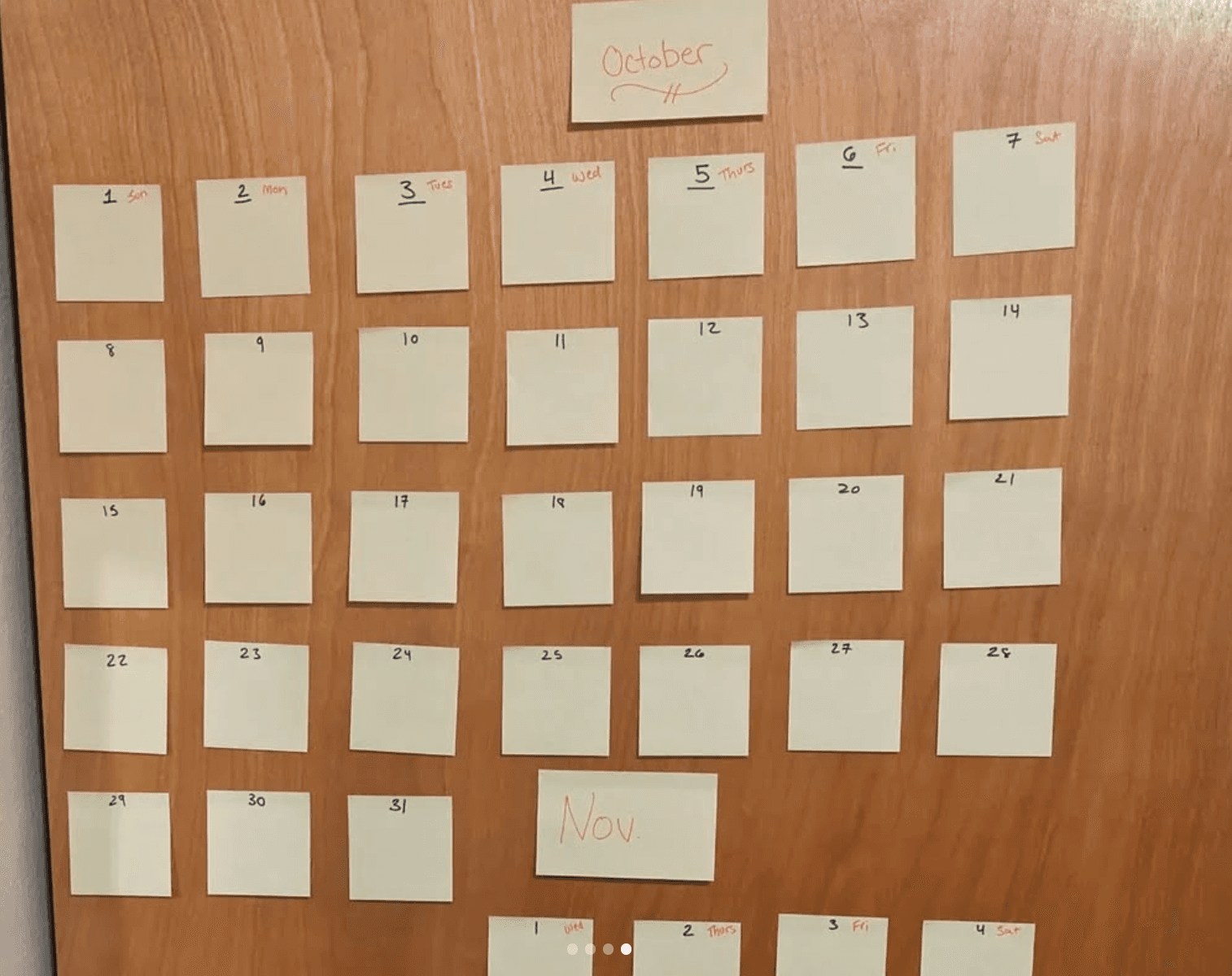
This was my closet door, where I mapped out the entire quarter. There were different colored notes and markers for assignments, in class work, lectures, etc. Seeing it all laid out at once, visually, helped me make sure everything was spaced out well and the pace of the class would be even.
The Major Assignmentes were as follows:
Personal Blog Post: More like a personal LinkedIN post at this point, students could choose between three options to write a blog post.
Goal: Help them practice the fundamentals of Technical Communication: Audience, Purpose, Clarity/Concision, Standardization.
Real-World Parallel: LinkedIN posts, but more broadly, writing for a variety of audiences & using jargon effectively.
Assessment: TA & Peer review, instructor feedback.
Ethics Presentation: Students chose a real-world ethical conundrum and were given 5 minutes to present it to the class.
Goal: Learn and apply the basics of visual communication, practice public speaking, understand engineering ethics.
Real-World Parallel: Most engineers would say their job involved making and presenting many PowerPoints, and although fewer, many have or will wrestle with an ethical conundrum at some point.
Assessment: Peer Review (practice), Instructor Evaluation using a rubric during in-class Presentation
Group Research Paper: Students formed groups and wrote a research paper on a topic of their choice to a professional audience.
Goal: Collaboration, writing a document with citation and structure for a professional audience, persuasion methods.
Real-World Parallel: Engineers rarely work alone, so learning teamwork is important, and especially for engineers who would want to go to graduate school, learning how to write a research paper is vital.
Assessment: Individual & Group Peer Review, Instructor Feedback & Evaluation.
Minor Assignments:
Elevator Pitch: Students had 2 minutes to give a speech in front of the class about their own experiences or a topic of interest, practicing public speaking and concision.
Resume & Cover Letter Writing: Exploring how to write a resume & cover letter for job and internship applications.
AI Tools & Ethics: Understand the history and ethics of AI, from generative tools to broader large language models, showing what they do well and what they do poorly. For students who had never tried one of these tools, it was a good primer on understanding their possibility and limitations, and for students who were familiar with the tools it was illuminating to get the background on these topics.
The Design Principles:
Make it relevant: Every topic needed to have a "real world" application. 2-minute "elevator speeches" were reformatted as answering the first question of a job interview, understanding tone became analyzing how to write a professional email, etc.
Iterate Constantly: Especially the first quarter, where I was working non-stop to develop all my course materials, I kept trying to change things behind the scenes to make things work better for this and future courses. For example, because I had been optimizing for quantity over quality, my early slides were cobbled together from multiple sources and not very pretty. I gave a few of those very slides to my students, saying that I knew they weren't good and asking for their help to improve them, having them practice the visual communication techniques.
Engage with Humor: My first quarter, the main feedback I got was "more activities, fewer lectures." They had liked the activities I had brought but found lectures understandably tedious, so I started coming up with fun activities, the most popular of what would be later dubbed "Rubber Duck Ransom Notes"
Prof. Shah was very kind and insightful when answering questions. She took so much care in making our class entertaining and welcoming. The world needs more teachers like her.
2024 Student
From the first to third quarter teaching, I added a multitude of in-class activities, attempting to make complex lecture topics not only practical but fun. The most popular of these was dubbed the "Rubber Duck Ransom Note"
Three of the most important topics in Technical Communication are Audience, Purpose & Context. When searching online for activities for this, I found one that said "have students write ransom notes" which, while effective, sounded a bit dark. But the more I tried to find or build a new activity, I kept thinking about those ransom notes, so I built a funnier version.
"You are in a prank war with your friend and have stolen their prized rubber duck collection. Write a ransom note to give to them.."
There are plenty of ways to modify this: writing to a an enemy rather than a friend, going for a funnier or darker tone, changing the context where this ransom note would be delivered, having the purpose be to get an object back or to, in one groups example, be taken on a date in exchange for returning the prized rubber ducks. Most importantly, it was fun. The students not only had a clearer idea of how to communicate and use these topics outside of the class, but were laughing the whole way through. Other instructors made their own versions of this, having students write product pitches rather than ransom notes, but they all had that thread of making an abstract topic entertaining and understandable.
Reflections:
Teaching:
Even though I wasn't an experienced instructor, students could sense that I cared about them and the material, and responded well to my enthusiasm and transparency.
Always share the why. It shows that you respect their time and energy as well as makes the work relevant.
Teaching is design, and requires a similar process. Treating my class like a product worked quite well! It kept me constantly learning and developing every quarter.
Instructional Design:
Active Learning > Passive Lecturing. There's of course going to be lecturing, but most of the learning will happen when the material is practiced.
Plan out the class as a whole and then break each piece down lecture by lecture so assignments become managable and iterative.
Every topic should have a clear "why" and application out of respect for students time and energy.
Skills I developed:
Curriculum Development & Instructional Design Software (Canvas LMS)
Learning outcome assessment
Facilitation and classroom management
Adapting to diverse learning styles
Giving constructive feedback at scale
Using humor as a learning tool
I found myself using the topics we learned in class in my everyday life, and it made my regular communication better. - Student Feedback, Autumn 2023
In the Future:
More activities! With more time and now three quarters of experience, I can expand upon in-class activities like analyzing bad emails and make the rubber duck ransom notes an earlier assignment that helps break the ice and bring students together.
It's not enough to explain why, you have to help students care about why, and I'd want to expand upon that.
More professional preparation. Applying to jobs is tough, and we only touched on writing a resume and interviewing. I want to give them more practice on those skills.
Improve my academic knowledge of Technical Communication to bring together my professional experience with a more robust base.